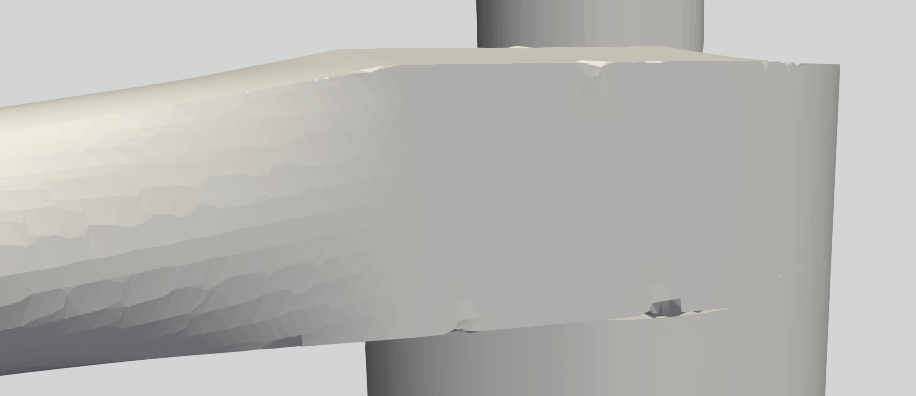
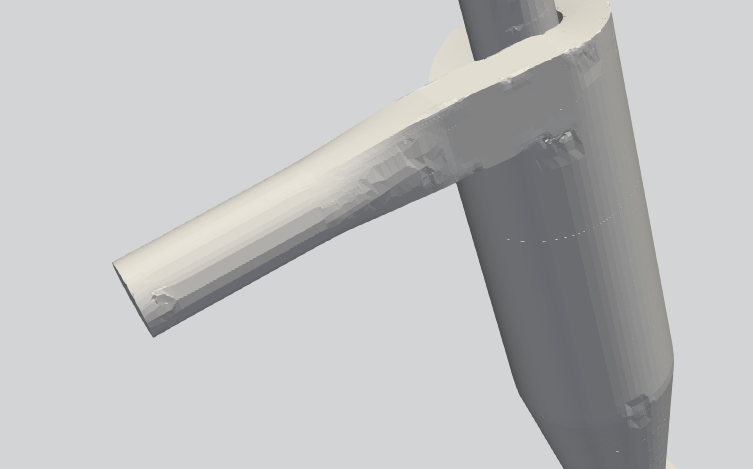
// Which of the steps to run castellatedMesh true; snap true; addLayers true;
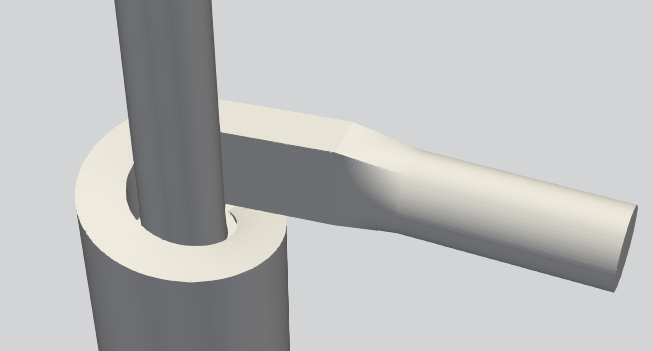
// Geometry. Definition of all surfaces. All surfaces are of class // searchableSurface. // Surfaces are used // - to specify refinement for any mesh cell intersecting it // - to specify refinement for any mesh cell inside/outside/near // - to 'snap' the mesh boundary to the surface geometry { LEI-cyclone.stl { type triSurfaceMesh; } };
// Settings for the castellatedMesh generation. castellatedMeshControls { // Refinement parameters // ~~~~~~~~~~~~~~~~~~~~~
// If local number of cells is >= maxLocalCells on any processor // switches from from refinement followed by balancing // (current method) to (weighted) balancing before refinement. maxLocalCells 1000000;
// Overall cell limit (approximately). Refinement will stop immediately // upon reaching this number so a refinement level might not complete. // Note that this is the number of cells before removing the part which // is not 'visible' from the keepPoint. The final number of cells might // actually be a lot less. maxGlobalCells 80000000;
// The surface refinement loop might spend lots of iterations refining just a // few cells. This setting will cause refinement to stop if <= minimumRefine // are selected for refinement. Note: it will at least do one iteration // (unless the number of cells to refine is 0) minRefinementCells 0;
// Allow a certain level of imbalance during refining // (since balancing is quite expensive) // Expressed as fraction of perfect balance (= overall number of cells / // nProcs). 0=balance always. maxLoadUnbalance 0;
// Number of buffer layers between different levels. // 1 means normal 2:1 refinement restriction, larger means slower // refinement. nCellsBetweenLevels 1;
// Explicit feature edge refinement // ~~~~~~~~~~~~~~~~~~~~~~~~~~~~~~~~ // Specifies a level for any cell intersected by its edges. // This is a featureEdgeMesh, read from constant/triSurface for now. features ( { file "LEI-cyclone.eMesh"; level 1; }
);
// Surface based refinement // ~~~~~~~~~~~~~~~~~~~~~~~~
// Specifies two levels for every surface. The first is the minimum level, // every cell intersecting a surface gets refined up to the minimum level. // The second level is the maximum level. Cells that 'see' multiple // intersections where the intersections make an // angle > resolveFeatureAngle get refined up to the maximum level.
refinementSurfaces { LEI-cyclone.stl { level (00); regions { inlet { name inlet; level (00 ); patchInfo { type patch; } } outlet { name outlet; level (00 ); patchInfo { type patch; } } body-topwall { name body-topwall; level (11); patchInfo { type wall; } } body-wall { name body-wall; level (11); patchInfo { type wall; } } finder-in { name finder-in; level (11); patchInfo { type wall; } } finder-out { name finder-out; level (11); patchInfo { type wall; } } hopper { name hopper; level (11); patchInfo { type wall; } } // inlet-wall-1 // { // name inlet-wall-1; // level (1 1); // patchInfo { type patch; } // } inlet-wall-2 { name inlet-wall-2; level (11); patchInfo { type wall; } } inlet-wall-3 { name inlet-wall-3; level (11); patchInfo { type wall; } } } } }
// Specifies refinement level for cells in relation to a surface. One of // three modes // - distance. 'levels' specifies per distance to the surface the // wanted refinement level. The distances need to be specified in // descending order. // - inside. 'levels' is only one entry and only the level is used. All // cells inside the surface get refined up to the level. The surface // needs to be closed for this to be possible. // - outside. Same but cells outside.
refinementRegions { }
// Mesh selection // ~~~~~~~~~~~~~~
// After refinement patches get added for all refinementSurfaces and // all cells intersecting the surfaces get put into these patches. The // section reachable from the locationInMesh is kept. // NOTE: This point should never be on a face, always inside a cell, even // after refinement. locationInMesh (0.0010.0010.001);
// Whether any faceZones (as specified in the refinementSurfaces) // are only on the boundary of corresponding cellZones or also allow // free-standing zone faces. Not used if there are no faceZones. allowFreeStandingZoneFaces true; }
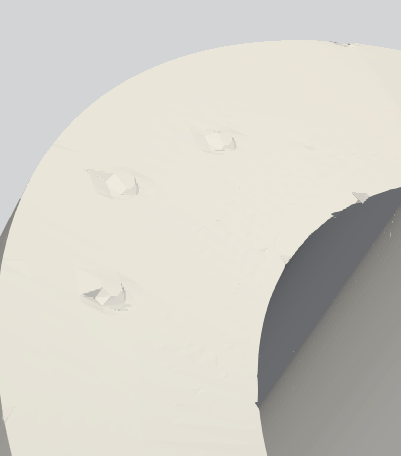
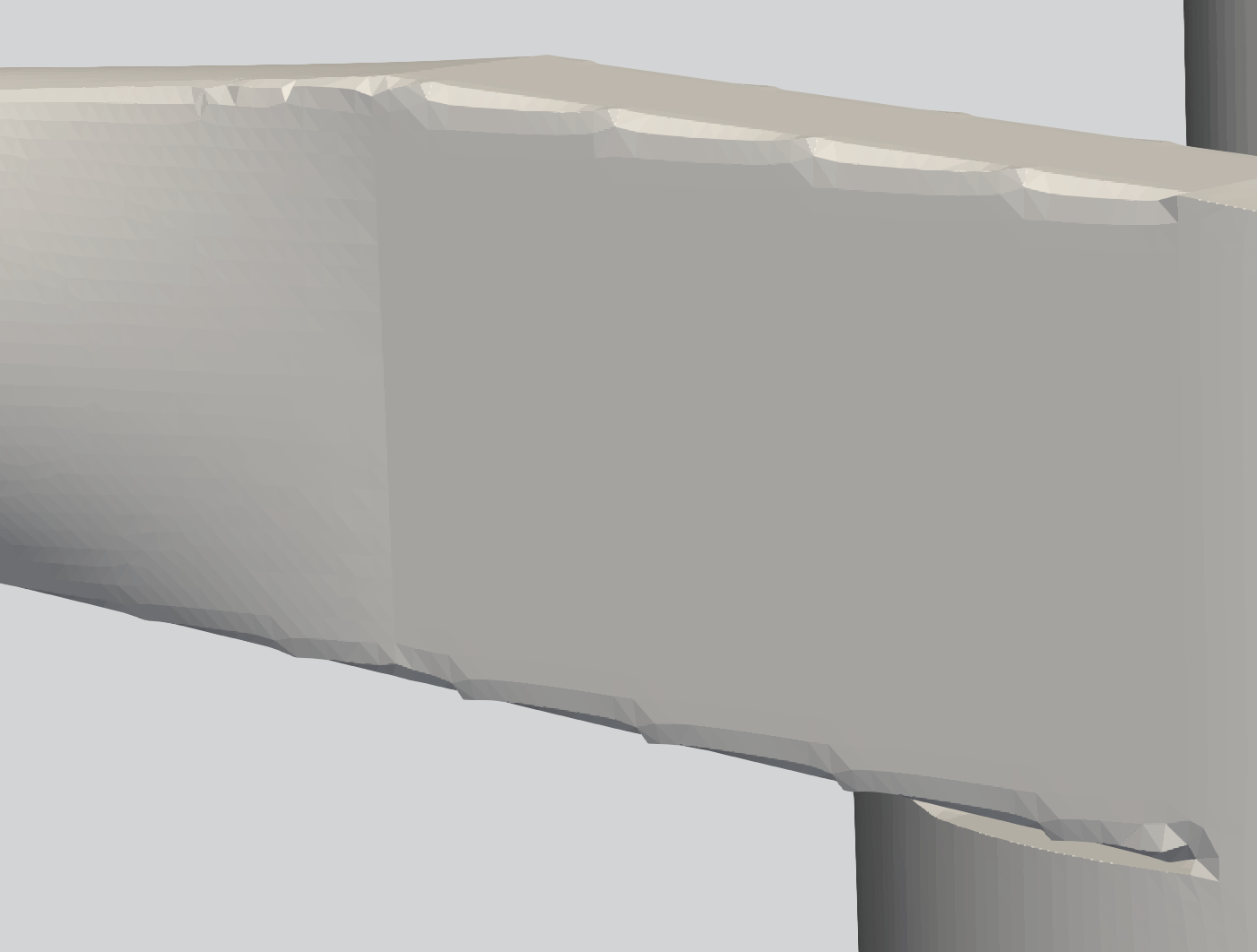
// Settings for the snapping. snapControls { //- Number of patch smoothing iterations before finding correspondence // to surface nSmoothPatch 1;
//- Relative distance for points to be attracted by surface feature point // or edge. True distance is this factor times local // maximum edge length. tolerance 1.0; //2.0;
//- Number of mesh displacement relaxation iterations. nSolveIter 300;
//- Maximum number of snapping relaxation iterations. Should stop // before upon reaching a correct mesh. nRelaxIter 40;
// Feature snapping
//- Number of feature edge snapping iterations. // Leave out altogether to disable. nFeatureSnapIter 10;
//- Detect (geometric only) features by sampling the surface // (default=false). implicitFeatureSnap false;
//- Use castellatedMeshControls::features (default = true) explicitFeatureSnap true;
//- Detect points on multiple surfaces (only for explicitFeatureSnap) multiRegionFeatureSnap true; }
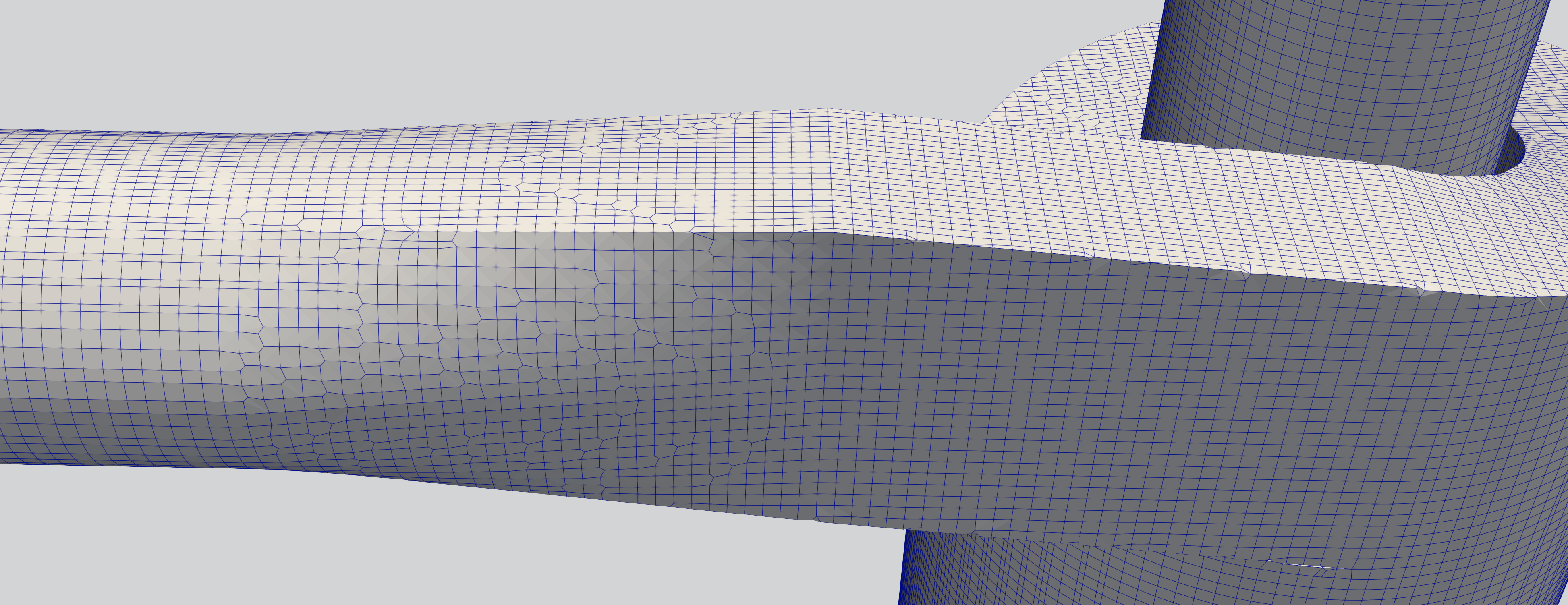
// Settings for the layer addition. addLayersControls { // Are the thickness parameters below relative to the undistorted // size of the refined cell outside layer (true) or absolute sizes (false). relativeSizes false;
// Per final patch (so not geometry!) the layer information layers { body-wall { nSurfaceLayers 5; }
finder-in { nSurfaceLayers 5; }
finder-out { nSurfaceLayers 5; }
}
// Expansion factor for layer mesh expansionRatio 1.25;
// Wanted thickness of final added cell layer. If multiple layers // is the thickness of the layer furthest away from the wall. // Relative to undistorted size of cell outside layer. // See relativeSizes parameter. finalLayerThickness 0.001;
// Minimum thickness of cell layer. If for any reason layer // cannot be above minThickness do not add layer. // Relative to undistorted size of cell outside layer. minThickness 0.0001;
// If points get not extruded do nGrow layers of connected faces that are // also not grown. This helps convergence of the layer addition process // close to features. // Note: changed(corrected) w.r.t 17x! (didn't do anything in 17x) nGrow 1;
// Advanced settings
// When not to extrude surface. 0 is flat surface, 90 is when two faces // are perpendicular featureAngle 45;
// At non-patched sides allow mesh to slip if extrusion direction makes // angle larger than slipFeatureAngle. slipFeatureAngle 25;
// Maximum number of snapping relaxation iterations. Should stop // before upon reaching a correct mesh. nRelaxIter 10;
// Number of smoothing iterations of surface normals nSmoothSurfaceNormals 4;
// Number of smoothing iterations of interior mesh movement direction nSmoothNormals 3;
// Smooth layer thickness over surface patches nSmoothThickness 10;
// Stop layer growth on highly warped cells maxFaceThicknessRatio 0.5;
// Reduce layer growth where ratio thickness to medial // distance is large maxThicknessToMedialRatio 0.2;
// Angle used to pick up medial axis points // Note: changed(corrected) w.r.t 17x! 90 degrees corresponds to 130 in 17x. minMedianAxisAngle 90;
// Create buffer region for new layer terminations nBufferCellsNoExtrude 0;
// Overall max number of layer addition iterations. The mesher will exit // if it reaches this number of iterations; possibly with an illegal // mesh. nLayerIter 50; }
// Generic mesh quality settings. At any undoable phase these determine // where to undo. meshQualityControls { #includeEtc "caseDicts/meshQualityDict"
// Advanced
//- Number of error distribution iterations nSmoothScale 4; //- amount to scale back displacement at error points errorReduction 0.75; }
// Merge tolerance. Is fraction of overall bounding box of initial mesh. // Note: the write tolerance needs to be higher than this. mergeTolerance 1e-6;