OpenFOAM-2.3.x 中的 twoPhaseEulerFoam 解析之 TurbulenceModel 发表于 2026-07-16 | 更新于 2026-07-16
| 浏览量:
OpenFOAM-2.3.x 中的 twoPhaseEulerFoam 解析之 TurbulenceModel 转自:https://xiaopingqiu.github.io/,侵删
仅仅觉得都挺有用的,所以转发一下。仅仅是想做个备份,希望不要某天淹没在互联网的长河里kineticTheoryModel 类的解读时前面提到过, kineticTheoryModel 使用了跟湍流模型一样的接口。这一篇,就来看一下 twoPhaseEulerFoam 中的湍流模型。
OpenFOAM-2.3.x 中的twoPhaseEulerFoam 流体相可以调用 RAS 和 LES 湍流模型,固相可以使用两种计算固相应力的“湍流模型”。divDevRhoReff 函数的形式,主要有三种类型:用于固相的 phasePressure 和 kineticTheoryModel 以及用于流体相的 RAS 模型或 LES 模型,以 kEpsilon 模型为例。此外,在”pEqn.H”里,还需要用到 pPrime() 函数,这个函数主要是在处理颗粒相的压力时有意义,所以,在 phasePressure 和 kineticTheoryModel 两个模型中,这个函数也需要关注一下。
1 phasePressure 很显然,这个是用于固相的,只考虑所谓固相压力,所以理论上, divDevRhoReff函数应该是对固相动量方程没有贡献的,实际上也正是如此,其定义如下:
1
2
3
4
5
6
7
8
9
10
11
12
13
14
15
Foam::tmp<Foam::fvVectorMatrix> Foam::RASModels::phasePressureModel::divDevRhoReff ( volVectorField& U ) const { return tmp<fvVectorMatrix> ( new fvVectorMatrix ( U, this->rho_.dimensions()*dimensionSet(0, 4, -2, 0, 0) ) ); }
经测验,这一项对 fvVectorMatrix 的贡献是零。
1
2
3
4
5
6
7
8
9
10
11
12
13
14
15
16
17
18
19
20
21
22
23
Foam::tmp<Foam::volScalarField> Foam::RASModels::phasePressureModel::pPrime() const { return g0_ *min ( exp(preAlphaExp_*(this->alpha_ - alphaMax_)), expMax_ ); } Foam::tmp<Foam::surfaceScalarField> Foam::RASModels::phasePressureModel::pPrimef() const { return g0_ *min ( exp(preAlphaExp_*(fvc::interpolate(this->alpha_) - alphaMax_)), expMax_ ); }
phasePressure 模型计算的“固相压力”为radialModel 中的$g_0$ 不是一个概念!
2 kineticTheory KTGF 模型, 代码如下:
1
2
3
4
5
6
7
8
9
10
11
12
13
14
15
16
17
18
19
20
21
22
23
24
25
26
27
28
29
30
31
32
33
34
35
36
37
38
39
40
41
42
43
44
45
46
47
48
49
50
51
52
53
54
55
56
57
58
59
60
61
62
63
64
65
66
67
68
69
70
71
72
73
74
Foam::tmp<Foam::fvVectorMatrix> Foam::RASModels::kineticTheoryModel::divDevRhoReff ( volVectorField& U ) const { return ( - fvm::laplacian(this->rho_*this->nut_, U) - fvc::div ( (this->rho_*this->nut_)*dev2(T(fvc::grad(U))) + ((this->rho_*lambda_)*fvc::div(this->phi_)) *dimensioned<symmTensor>("I", dimless, symmTensor::I) ) ); } Foam::tmp<Foam::volScalarField> Foam::RASModels::kineticTheoryModel::pPrime() const { // Local references const volScalarField& alpha = this->alpha_; const volScalarField& rho = phase_.rho(); return ( Theta_ *granularPressureModel_->granularPressureCoeffPrime ( alpha, radialModel_->g0(alpha, alphaMinFriction_, alphaMax_), radialModel_->g0prime(alpha, alphaMinFriction_, alphaMax_), rho, e_ ) + frictionalStressModel_->frictionalPressurePrime ( alpha, alphaMinFriction_, alphaMax_ ) ); } Foam::tmp<Foam::surfaceScalarField> Foam::RASModels::kineticTheoryModel::pPrimef() const { // Local references const volScalarField& alpha = this->alpha_; const volScalarField& rho = phase_.rho(); return fvc::interpolate ( Theta_ *granularPressureModel_->granularPressureCoeffPrime ( alpha, radialModel_->g0(alpha, alphaMinFriction_, alphaMax_), radialModel_->g0prime(alpha, alphaMinFriction_, alphaMax_), rho, e_ ) + frictionalStressModel_->frictionalPressurePrime ( alpha, alphaMinFriction_, alphaMax_ ) ); }
这一部分详细的公式已在 kineticTheoryModel 解读部分分析了,不再赘述。
3 kEpsilon (OpenFOAM-2.3.x/src/TurbulenceModels/turbulenceModels/RAS/kEpsilon) 这个代表的是RAS湍流模型。(其实还有 LES 模型,只是 RAS 与 LES 的 divDevRhoReff函数形式应该是一样的),函数所在代码路径为:OpenFOAM-2.3.x/src/TurbulenceModels/turbulenceModels/eddyViscosity/eddyViscosity.C
1
2
3
4
5
6
7
8
9
10
11
12
13
template<class BasicTurbulenceModel> Foam::tmp<Foam::fvVectorMatrix> Foam::eddyViscosity<BasicTurbulenceModel>::divDevRhoReff ( volVectorField& U ) const { return ( - fvm::laplacian(this->alpha_*this->rho_*this->nuEff(), U) - fvc::div((this->alpha_*this->rho_*this->nuEff())*dev2(T(fvc::grad(U)))) ); }
kEpsilon 类中没有重新定义 pPrime() 函数,而是直接继承 PhaseCompressibleTurbulenceModel 类中的定义,返回零,这里就不列出代码了。
湍流模型的调用 湍流模型的调用过程,值得看一下,重点是看一下湍流模型类的继承派生关系,以 kineticTheoryModel 为例。kineticTheoryModel 类的声明和构造函数部分如下:
1
2
3
4
5
6
7
8
9
10
11
12
13
14
15
16
17
18
19
20
21
22
23
24
25
26
27
28
29
30
31
32
33
34
class kineticTheoryModel : public eddyViscosity < RASModel<PhaseCompressibleTurbulenceModel<phaseModel> > > { ...... } Foam::RASModels::kineticTheoryModel::kineticTheoryModel ( const volScalarField& alpha, const volScalarField& rho, const volVectorField& U, const surfaceScalarField& alphaRhoPhi, const surfaceScalarField& phi, const transportModel& phase, const word& propertiesName, const word& type ) : eddyViscosity<RASModel<PhaseCompressibleTurbulenceModel<phaseModel> > > ( type, alpha, rho, U, alphaRhoPhi, phi, phase, propertiesName ), ......
可见, kineticTheoryModel 类继承自 eddyViscosity 类,并且用 RASModel<PhaseCompressibleTurbulenceModel<phaseModel> > 来实例化eddyViscosity 类中的模板参数。
再来看eddyViscosity 类:
1
2
3
4
5
6
7
8
9
10
11
12
13
14
15
16
17
18
19
20
21
22
23
24
25
26
27
28
29
30
31
32
33
34
35
36
37
38
39
40
41
42
43
44
45
46
47
48
49
50
51
52
template<class BasicTurbulenceModel> class eddyViscosity : public BasicTurbulenceModel { protected: // Protected data // Fields volScalarField nut_; // Protected Member Functions virtual void correctNut() = 0; template<class BasicTurbulenceModel> Foam::eddyViscosity<BasicTurbulenceModel>::eddyViscosity ( const word& modelName, const alphaField& alpha, const rhoField& rho, const volVectorField& U, const surfaceScalarField& alphaRhoPhi, const surfaceScalarField& phi, const transportModel& transport, const word& propertiesName ) : BasicTurbulenceModel ( modelName, alpha, rho, U, alphaRhoPhi, phi, transport, propertiesName ), nut_ ( IOobject ( IOobject::groupName("nut", U.group()), this->runTime_.timeName(), this->mesh_, IOobject::MUST_READ, IOobject::AUTO_WRITE ), this->mesh_ ) {}
注意,这里有意思的来了, eddyViscosity 类继承自其模板参数代表的类,具体继承自哪个类,要等模板实例化了才知道。这种用法我还是头一次接触。根据上面 kineticTheoryModel 类的构造函数,可知 eddyViscosity 类在当前分析的情况下,将继承自 RASModel<PhaseCompressibleTurbulenceModel<phaseModel> > 。
继续看 RASModel 类的定义:
1
2
3
4
5
6
7
8
9
10
11
12
13
14
15
16
17
18
19
20
21
22
23
24
25
26
27
28
29
30
31
32
33
34
35
36
37
38
39
40
41
42
43
44
45
46
47
48
49
50
51
52
53
54
55
56
57
58
59
60
61
62
63
64
65
66
67
68
69
70
71
72
73
74
75
76
77
78
79
80
81
82
83
84
85
86
87
88
89
90
91
92
93
94
95
96
97
98
99
100
101
template<class BasicTurbulenceModel> class RASModel : public BasicTurbulenceModel { protected: // Protected data //- RAS coefficients dictionary dictionary RASDict_; //- Turbulence on/off flag Switch turbulence_; //- Flag to print the model coeffs at run-time Switch printCoeffs_; //- Model coefficients dictionary dictionary coeffDict_; //- Lower limit of k dimensionedScalar kMin_; //- Lower limit of epsilon dimensionedScalar epsilonMin_; //- Lower limit for omega dimensionedScalar omegaMin_; ...... }; // constructor template<class BasicTurbulenceModel> Foam::RASModel<BasicTurbulenceModel>::RASModel ( const word& type, const alphaField& alpha, const rhoField& rho, const volVectorField& U, const surfaceScalarField& alphaRhoPhi, const surfaceScalarField& phi, const transportModel& transport, const word& propertiesName ) : BasicTurbulenceModel ( alpha, rho, U, alphaRhoPhi, phi, transport, propertiesName ), RASDict_(this->subOrEmptyDict("RAS")), turbulence_(RASDict_.lookup("turbulence")), printCoeffs_(RASDict_.lookupOrDefault<Switch>("printCoeffs", false)), coeffDict_(RASDict_.subOrEmptyDict(type + "Coeffs")), kMin_ ( dimensioned<scalar>::lookupOrAddToDict ( "kMin", RASDict_, SMALL, sqr(dimVelocity) ) ), epsilonMin_ ( dimensioned<scalar>::lookupOrAddToDict ( "epsilonMin", RASDict_, SMALL, kMin_.dimensions()/dimTime ) ), omegaMin_ ( dimensioned<scalar>::lookupOrAddToDict ( "omegaMin", RASDict_, SMALL, dimless/dimTime ) ) { // Force the construction of the mesh deltaCoeffs which may be needed // for the construction of the derived models and BCs this->mesh_.deltaCoeffs(); }
RASModel 类也是继承自模板参数代表的类,在这里分析的情况下,模板参数将实例化为 PhaseCompressibleTurbulenceModel<phaseModel> ,所以, RASModel 类也将继承自 PhaseCompressibleTurbulenceModel<phaseModel>。
PhaseCompressibleTurbulenceModel 类定义如下:
1
2
3
4
5
6
7
8
9
10
11
12
13
14
15
16
17
18
19
20
21
22
23
24
25
26
27
28
29
30
31
32
33
34
35
36
37
38
39
40
41
42
43
44
45
46
47
48
49
50
51
template<class TransportModel> class PhaseCompressibleTurbulenceModel : public TurbulenceModel < volScalarField, volScalarField, compressibleTurbulenceModel, TransportModel > { public: typedef volScalarField alphaField; typedef volScalarField rhoField; typedef TransportModel transportModel; ...... ...... }; template<class TransportModel> Foam::PhaseCompressibleTurbulenceModel<TransportModel>:: PhaseCompressibleTurbulenceModel ( const volScalarField& alpha, const volScalarField& rho, const volVectorField& U, const surfaceScalarField& alphaRhoPhi, const surfaceScalarField& phi, const transportModel& transport, const word& propertiesName ) : TurbulenceModel < volScalarField, volScalarField, compressibleTurbulenceModel, transportModel > ( alpha, rho, U, alphaRhoPhi, phi, transport, propertiesName ) {}
可见, PhaseCompressibleTurbulenceModel 类继承自 TurbulenceModel 类,并且要注意给 TurbulenceModel 的模板代入的实例化参数。
继续深入,来看 TurbulenceModel 的定义,
1
2
3
4
5
6
7
8
9
10
11
12
13
14
15
16
17
18
19
20
21
22
23
24
25
26
27
28
29
30
31
32
33
34
35
36
37
38
39
40
41
42
43
44
45
46
47
48
49
50
51
52
53
54
55
56
57
58
59
template < class Alpha, class Rho, class BasicTurbulenceModel, class TransportModel > class TurbulenceModel : public BasicTurbulenceModel { public: typedef Alpha alphaField; typedef Rho rhoField; typedef TransportModel transportModel; protected: // Protected data const alphaField& alpha_; const transportModel& transport_; ...... ...... }; template < class Alpha, class Rho, class BasicTurbulenceModel, class TransportModel > Foam::TurbulenceModel<Alpha, Rho, BasicTurbulenceModel, TransportModel>:: TurbulenceModel ( const alphaField& alpha, const rhoField& rho, const volVectorField& U, const surfaceScalarField& alphaRhoPhi, const surfaceScalarField& phi, const transportModel& transport, const word& propertiesName ) : BasicTurbulenceModel ( rho, U, alphaRhoPhi, phi, propertiesName ), alpha_(alpha), transport_(transport) {}
TurbulenceModel 继承自模板的第三个参数对应的类,从 PhaseCompressibleTurbulenceModel 的定义可知,这里是 compressibleTurbulenceModel 。此外,还要注意这个类有一个数据成员是 alpha_,在派生类的某些地方会调用这个数据成员。
接着再看, compressibleTurbulenceModel,
1
2
3
4
5
6
7
8
9
10
11
12
13
14
15
16
17
18
19
20
21
22
23
24
25
26
27
28
29
30
31
32
class compressibleTurbulenceModel : public turbulenceModel { protected: // Protected data const volScalarField& rho_; ...... ...... }; Foam::compressibleTurbulenceModel::compressibleTurbulenceModel ( const volScalarField& rho, const volVectorField& U, const surfaceScalarField& alphaRhoPhi, const surfaceScalarField& phi, const word& propertiesName ) : turbulenceModel ( U, alphaRhoPhi, phi, propertiesName ), rho_(rho) {}
这个类继承自 turbulenceModel ,并且有一个数据成员 rho_ 。
最底层的是 turbulenceModel 类了,其定义如下:
1
2
3
4
5
6
7
8
9
10
11
12
13
14
15
16
17
18
19
20
21
22
23
24
25
26
27
28
29
30
31
32
33
34
35
36
37
38
39
40
41
42
43
44
45
46
47
48
49
class turbulenceModel : public IOdictionary { protected: // Protected data const Time& runTime_; const fvMesh& mesh_; const volVectorField& U_; const surfaceScalarField& alphaRhoPhi_; const surfaceScalarField& phi_; //- Near wall distance boundary field nearWallDist y_; ...... ...... }; Foam::turbulenceModel::turbulenceModel ( const volVectorField& U, const surfaceScalarField& alphaRhoPhi, const surfaceScalarField& phi, const word& propertiesName ) : IOdictionary ( IOobject ( IOobject::groupName(propertiesName, U.group()), U.time().constant(), U.db(), IOobject::MUST_READ_IF_MODIFIED, IOobject::NO_WRITE ) ), runTime_(U.time()), mesh_(U.mesh()), U_(U), alphaRhoPhi_(alphaRhoPhi), phi_(phi), y_(mesh_) {}
这个类里定义了数据成员 U_,在 kineticTheoryModel 类中用到了。
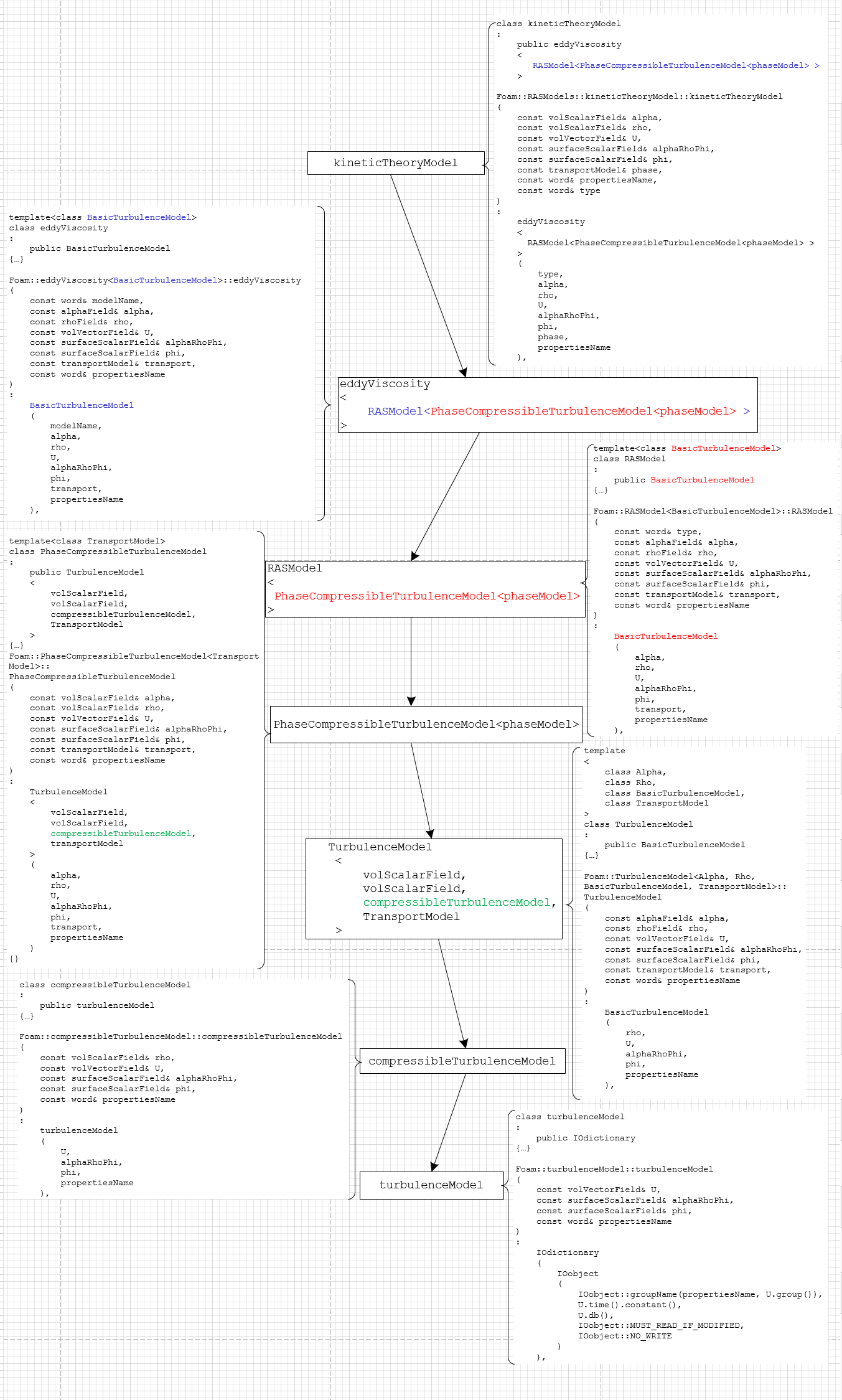
总结一下,湍流模型的继承派生关系如下图(看大图请右键点击图片,选“在新标签页中打开”):
像上面这种“类继承其模板参数所代表的类”的用法,在 OpenFOAM 中使用很普遍,最近在看的 thermodynamics 相关的代码里也大量使用了这种模式。不知道这是不是一种 C++ 的 design pattern?这方面我的理解还很浅显。